Showing posts with label payoff debt. Show all posts

Tuesday, January 15, 2013

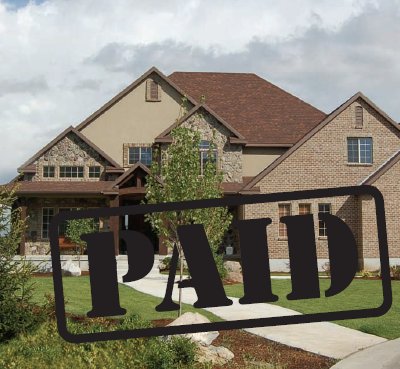
Tips to Pay Down a Mortgage

Paying off a mortgage seems like a daunting task, but every journey of a thousand miles begins with a simple step.  Start your journey by making payments on time, every time. Never bite off more than you can chew, and this may be very possible.

Before rushing to pay off your mortgage, make sure there are no early payment penalties built into your contract.  Most conventional mortgages through Fannie Mae, Freddie Mac, and the FHA don't have penalties like this. If you arranged some type of private financing, however, it's possible you might have a pre-payment penalty. In that case, you should consider putting the extra "payment" into a sinking fund or money market, to be used in the future.

Pay off your mortgage by sending in more than the required payments each month. Sell some things online and put that money towards your mortgage to pay it off a little bit faster.  If you can provide even a little bit extra in each monthly mortgage payment it will go to principal, and help to pay down your mortgage that little bit quicker.

Need help finding a way to make that extra payment.  Look at your budget. Do you eat out often? The average family eats out 4-5 times a week. Figuring the average size of a family being 3.5 and the average meal costing $8.00 that's around $400 every single month. For a family with a mortgage that needs to be paid off $400 a month will go a long ways. The family might now be happy. You might crave those meals... but when the mortgage is paid it's all going to be worth it. If it's difficult cut down eating out by half for starters and go from there. Simple life choices can make profound financial impacts.

You can pay off your mortgage faster by setting aside any raises, merit pay, or bonuses you receive.  Some people use their tax return as extra payment and on a month with an extra pay period, they make an extra mortgage payment.  Put this extra money into the "mortgage fund" and pay the mortgage down.

Find ways to save money by not buying new things. Use the money saved to make extra mortgage payments. You may have friends who would rather have their fingernails plucked out with pliers than live frugally, and that's completely fine. As long as they give you a call when they are taking stuff to the dump, you should be fine with their lifestyle choice. Don't let things go to waste. Live frugally, save money, and become debt free.

Thursday, November 29, 2012

Video: Frugal Living, practical tips for saving money - Lynnae McCoy


Frugalista and freelance writer Lynnae McCoy offers practical tips for saving money, from clipping coupons to saving on your food bill.

Recorded 16 August 2011


Like many people, Lynnae McCoy went to college and got her first credit card. Making minimum payments seemed to be the thing to do.  Of course, a real life and career doesn't always fit with a spending lifestyle.  Like many people, Lynnae froze her debts by sticking the credit cards in the freezer.  After freezing spending, this family looked at every item in their budget and tried to find ways to save money.

Tuesday, November 20, 2012

Creating a Debt Snowball

One day it just happens.  You open up all your bank and credit card statements and realize things are out of control. Debt is piling up.  You've got multiple balances with different companies and different interest rates.

Sometimes, this can be out of your control.  It might be medical bills or an underwater mortgage.  In some cases, it could be out of control spending. Whatever the reasons for your large debts, a debt snowball is a simple way to get things paid off.

A debt snowball works by combining effort with increasingly powerful results that snowball into a force that cannot be stopped.  Like a snowball rolling down a hill, it gathers more and more momentum to reach the ultimate goal, which is being debt free.

The beginning step is to get a full understanding of the problem.  When you are sick and go to the doctor, the first thing that they do is check your basic biometric readings.  Body temperature, pulse, blood pressure, height, and weight are all factors that relate to your physical health.

Your financial health is also just as measurable.  Creating a cash flow statement that shows your cash inflows and outflows helps you to understand where you are spending your money.  A balance sheet will help you to build a list of all your assets and debts, as well.

What is your Total Debt Number?


Make a list of all your different debt accounts, using your handy pencil (with an eraser, just in case) and a piece of paper.  Go through your bank statement to make sure you are capturing all the places you are sending your money, so that you don't forget one or two debts that could slip your mind.  Once you have that list complete, order the list from smallest to largest.   This is the order in which you will be paying off your loans.

This is where the debt snowball approach differs from so many others.  Some people may tell you that it is most logical to list your debts by the highest interest cost first and pay these off before the others.  This is logical, but it ignores a basic fact about human psychology.  Humans need to feel and see their progress towards a given goal.  Without that, they will give up.

The debt snowball is an incremental process.  In the first month, you use a zero based budget to eliminate unnecessary spending. Then, you apply all remaining funds to pay off your smallest debt.  You do this over and over again, consistently, month after month, until the smallest debt is paid.  Once that is complete, you take the money that you would be sending to the old debt and apply it to the next largest debt.  You will notice that this monthly payment starts to get larger and larger.  Each time you pay down a loan, your available cash flow increases.  This is the beauty of a snowball approach, you build momentum with each passing month.